Brand Is the Moat: Why AI Agents Make Brand Strategy More Important, Not Less
By Roey Granot · July 8, 2026
Category: marketing-insights
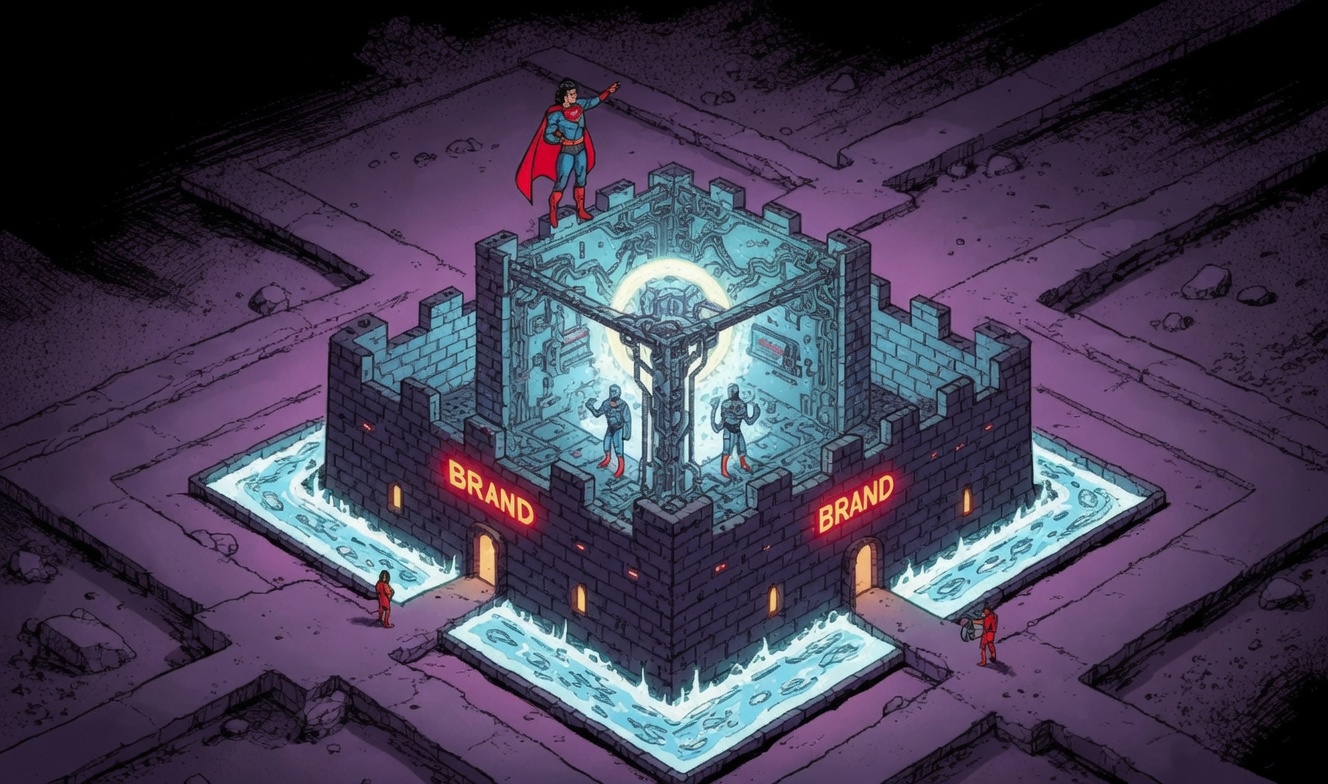
As AI agents flatten execution costs across every marketing team, brand strategy in the age of AI has become the only defensible competitive advantage left.
Key takeaways
The problem When AI makes content production nearly free, the only thing left to compete on is brand clarity.
Core insight AI agents amplify whatever strategic sharpness or fuzziness already exists in your brand foundation.
Practical outcome Audit your brand guidelines now to see if they are specific enough to actually brief an AI agent.
AI is making content production faster, cheaper, and accessible to every marketing team. That sounds like a competitive advantage, until every competitor has access to the same models, workflows, and distribution tools. When execution becomes abundant, it stops being the thing that separates one company from another.
The advantage moves upstream, to the clarity of your positioning, the strength of your point of view, and the consistency of your brand. AI agents do not create that differentiation. They amplify whatever already exists. Give them a sharp brand foundation and they scale it. Give them vague positioning and generic guidelines, and they produce generic content at extraordinary speed.
That is why brand strategy matters more in the age of AI, not less. As execution becomes easier to replicate, identity, trust, and recognition become the real moat.
AI Commoditizes Execution, Not Strategy
The fear most marketers are carrying right now is real: if AI agents can produce content at scale, instantly, and for nearly nothing, won't everything start to look the same? Won't differentiation dissolve?
Picture two competing brands. Same category. Similar budgets. Both have access to the same AI models, the same agent-driven content workflows, the same distribution channels. Brand A has a brand strategy that's genuinely sharp - clear positioning, a voice guide with actual teeth, a point of view that their team can argue out loud. Brand B has a PDF from 2021 that says things like "approachable but professional" and "customer-first."
Both teams brief their AI agents and push publish. Brand A's output sounds like Brand A. Brand B's output sounds like every other brand in the category. The AI didn't create that gap. It exposed one that was already there.
This is the precise framing that matters: AI agents are execution engines, and they amplify whatever strategic clarity - or fuzziness - you feed them. A mediocre brief produces mediocre content faster. A sharp brand foundation produces work that actually lands, at scale, consistently. The machine doesn't invent your identity. It broadcasts it.
Why Brand Moat Matters More, Not Less, in an AI-Saturated Market
There's a basic economic logic to this that's easy to overlook when you're deep in a sprint cycle.
When a capability is scarce, it commands a premium. For decades, the ability to produce high-quality content at volume was genuinely scarce - it required teams, time, and budget. That scarcity is disappearing. AI has made execution abundant. And when something becomes abundant, its marginal value drops. Speed and volume are no longer the advantage.
What doesn't get cheaper is trust. Recognition. The emotional residue a brand leaves in a customer's mind after years of consistent, relevant, honest communication. That's brand equity, and no model is generating it for you overnight. It accumulates through decisions made upstream of content - through positioning, through what you refuse to say as much as what you say, through the kind of company you actually are.
The counterintuitive read here is this: most marketers assume AI will commoditize their work. It won't - it will commoditize mediocre work. If your competitive advantage was always "we produce more content faster than our competitors," that advantage is already gone. But if your advantage is a brand that people genuinely recognize, prefer, and trust, AI makes that advantage more visible - because the noise floor drops and your signal stands out.
This is what Cannes was actually validating. Not AI as a production trick. Brand clarity as a structural moat.
How Leading Teams Are Splitting the Work
The teams doing this well right now aren't arguing about whether AI belongs in their workflow. They've moved past that. What they're working through is the allocation question: who owns what, and when.
A pattern that keeps appearing among brand-led marketing teams is what you might call the upstream migration. Brand strategists and senior creatives are spending more time earlier in the process - on positioning work, voice architecture, creative territory definition - and less time in the middle, where drafting and formatting live. The brief arrives, and instead of a writer spending two days outlining options, an AI agent produces four structural directions in forty minutes. The strategist reviews them against the brand, kills two, refines one, and sends it to a human editor for the final pass. The output is faster. More importantly, it's more consistently on-brand than what the team produced before, because the upstream clarity is tighter.
A second pattern: brand guidelines have become operational documents, not aspirational ones. Teams that are getting real value from AI agents have rewritten their brand voice guides specifically to be machine-readable - not as inspiration decks with mood boards and adjectives, but as specific, testable rules. "We never use passive constructions to describe customer problems." "Our tone in product copy is direct and slightly dry, not warm." "We don't use rhetorical questions as headers." Rules that an AI can follow, and that a human editor can check against. The brand document stops being a PDF and starts being a brief.
A third pattern, less common but worth noting: some teams have restructured quality control entirely. The human editor's job is no longer to fix grammar or improve sentence flow - AI handles the first pass of that. The editor's job is brand interrogation. Does this sound like us? Is this claim accurate? Does this reflect the position we've chosen, or does it drift? That's a different skill set than copy editing, and teams that have made the shift are producing cleaner work with fewer review cycles.
None of this is "humans out, AI in." It's a reallocation. Humans move upstream to strategy and downstream to judgment. The middle - first-draft content, basic optimization, structural formatting - becomes AI territory. That middle work wasn't where the value was anyway.
Implications for Your Marketing Stack and Team Structure
Tool selection looks different through this lens. The best AI agent for your team is not the one with the most features or the largest model behind it. It's the one that integrates tightest with your brand guidelines and gives your team meaningful control over the output. A system that lets you encode your voice, your positioning, your content rules - and that flags deviations rather than just producing volume - is worth more than a system that generates faster but drifts further.
On team structure: if you're still hiring junior writers primarily to produce first drafts, you're hiring for a role that AI is absorbing. That's not a judgment on those writers - it's a structural observation. The roles that are becoming more valuable are brand strategy, editorial judgment, creative direction, and the specific kind of quality control that requires understanding what the brand stands for. Those roles require a different interview question: not "can you write?" but "can you tell when writing is off-brand and articulate exactly why?"
There's a trap worth naming directly: the false economy of headcount reduction. "We can do more with fewer people" is true, in a narrow sense. But if you cut the writers, pocket the savings, and don't reinvest in brand strategy and creative direction, you haven't improved your marketing operation. You've automated mediocrity. The volume goes up. The quality of thinking stays flat or falls. The output is more of the same thing, faster. That's not a competitive advantage - it's a faster way to sound like everyone else.
The teams getting this right are reinvesting. They're using the efficiency gains to fund better brand work - proper positioning projects, genuine voice development, creative strategies that take more than a week to write. That investment is what makes the AI output worth anything.
Brand as Your Unfair Edge in the AI Era
Think of AI-driven execution as a filtering mechanism. When everyone can produce content at scale, the noise floor rises dramatically - and then the filter kicks in. Audiences develop faster reflexes for skipping generic content. Algorithms reward engagement signals that generic content can't generate. The brands that cut through aren't the ones producing the most. They're the ones that are unmistakably, specifically themselves.
Cannes Lions functions as a useful proxy for what the industry's best creative minds think matters. The work that won this cycle wasn't defined by its technical production. It was defined by its clarity of perspective. Brands that had something to say, said it in a way only they could say it, and trusted the idea enough to commit to it fully. That's a brand strategy decision, made long before any AI agent entered the picture.
The window on this is real. Right now, in most categories, AI adoption is uneven. Some teams are using it thoughtfully. Many are using it to generate volume. A smaller number are using it in combination with serious brand investment. That last group is building a moat. As AI adoption flattens across your category - and it will - the differentiating factor won't be who has access to the best tools. It will be who built the brand that the tools are amplifying.
The teams that do the brand work now, before AI adoption is universal in their space, will have a structural head start. Not because of the AI. Because of what they built before they turned it on.
Frequently Asked Questions
Isn't this just another marketing trend that will fade?
No. This is a structural shift in what's scarce and what's valuable. Execution capacity - the ability to produce content at volume - was genuinely scarce for decades. AI has made it abundant. Brand equity, trust, and recognition are not things AI generates automatically. They accumulate through strategic decisions made over time. That dynamic doesn't reverse when the next tool cycle arrives.
How do I know if this applies to my team right now?
A useful diagnostic: if more than half your creative team's time is going into drafting and formatting rather than strategic or editorial work, you're exposed. A second signal - if your brand guidelines couldn't be used to brief an AI agent (because they're too vague, too aspirational, or too old), your brand strategy isn't clear enough to be your moat yet. Both of those are fixable, but you need to see them clearly first.
What's the first practical step to start building brand as a competitive moat?
Audit your existing brand strategy against one test: is it specific enough to produce a consistent AI output? Can you write down rules - actual, testable rules - that an AI agent could follow and a human editor could check? If your brand voice guide still uses words like 'approachable' and 'innovative' without defining what that looks like in practice, start there. Rewrite it as operational instructions, not inspiration.
Does this only apply to large enterprise brands with dedicated brand teams?
The mechanics apply at any scale - possibly more urgently for smaller teams. A small brand team or independent creator who invests in clear positioning and voice now will produce AI-assisted content that sounds genuinely distinct. A large team with a vague brand strategy will produce large volumes of generic content. Size doesn't determine outcome here. Strategic clarity does.
Won't AI eventually be able to generate brand identity and positioning as well?
AI can assist with brand strategy work - analyzing competitive positioning, generating territory options, stress-testing messaging. But brand identity ultimately derives from what a company actually believes, who it serves, and what it refuses to do. Those are decisions that require human judgment, business context, and accountability. AI can inform them. It can't make them for you - and the brands that outsource that judgment entirely will show it.